Back to Mud: The Decolonial Architecture Movement Reimagining African Public Spaces
The exercise of visualizing modernity in cities often leads one to picture skyscrapers, grandiose bridges, and urban housing developments with tall glass windows. These have become the urban living infrastructures we know to be modern— those we crave, value, and race to build. Yet, there is an increasing cluster of African architects, designers, and engineers who are contesting these images of modernity as being neither desirable nor fit for public spaces in our African cities. Together, they form a pan-African movement of decolonial imaginaries seeking to deconstruct the Eurocentric disposition to architectural design that the continent has inherited through colonization. Instead, they long to reinstate and reimagine the sustainable, ecological, and ancestral architectural techniques that once dominated our landscapes. They are the trailblazers of today, interested in changing the way we build Africa and conscious that this will dictate the living of tomorrow.
From Lagos to Abidjan, Nairobi to Dakar, and Accra to Johannesburg, the African cities we know are simultaneously filled with the pre-colonial architecture of their past and racing to build the modern architecture that globalization demands of them. Yet, as they develop, they are often heading in a Western architectural direction that is not theirs. The architectural landscape in these cities is often modeled after Western ideologies of modernity, defined by architectural permanence through the use of concrete, steel, and glass, as well as enabled by taming, removing, or conquering nature to build infrastructure. Should we apply a decolonial lens to the issue, it becomes clear that this approach poses distinct challenges that have stark implications for the way the inhabitants of these cities interact with public spaces.
Climate varies from region to region across the African continent. As author Anouk Zijlma highlights, North Africa has an arid desert climate defined by high temperatures and little precipitation, while West and Central Africa have a monsoon climate with high temperatures coupled with soaring humidity and heavy season rains. This differs from East African climates defined by dry and rainy seasons, as well as from South African ones where a temperate climate dominates. This matters to recognize that, because seasons do not follow those of “summer, autumn, winter, spring” found in the Western world, and because heat is a constant variable in African climates the way it is not in Western countries, building African infrastructure must then require a vastly different approach to be adapted and responsive to local environments. In such climates, the adoption of Western architectural techniques inevitably leads to extreme heat retention, minimal shade, reduced air circulation, and poor lighting.
However, the answers to these challenges need not be far-fetched. They are found across Africa in villages where ancestral knowledge continues to inform the construction of public structures. In a 1974 article entitled “An Introduction to Indigenous African Architecture”, American architect Labelle Prussin highlighted that the circular form of the African mud hut works to concentrate thermal radiation in a “central, enclosed, interior space”. By reducing windows and limiting the dimension of the door opening, the insulating walls of the huts can accumulate and store the cool of the day rather than preserving heat as cement or concrete does. This technique is low-cost, financially accessible, and holds a visual African identity that is widely recognizable. The Great Mosque of Kong, a UNESCO World Heritage Site located in the North East of the Ivory Coast, is a great example of an international landmark built using Indigenous African architectural techniques. The neo-Sudanese-style mosque was built in the 17th century during the spread of Islam in sub-Saharan Africa using mud bricks consolidated with wooden beams. Skylights were also integrated into the roof to allow natural light to enter the building. The mosque is a jewel of architecture that speaks to a level of expertise and knowledge present in Indigenous African architectural techniques.
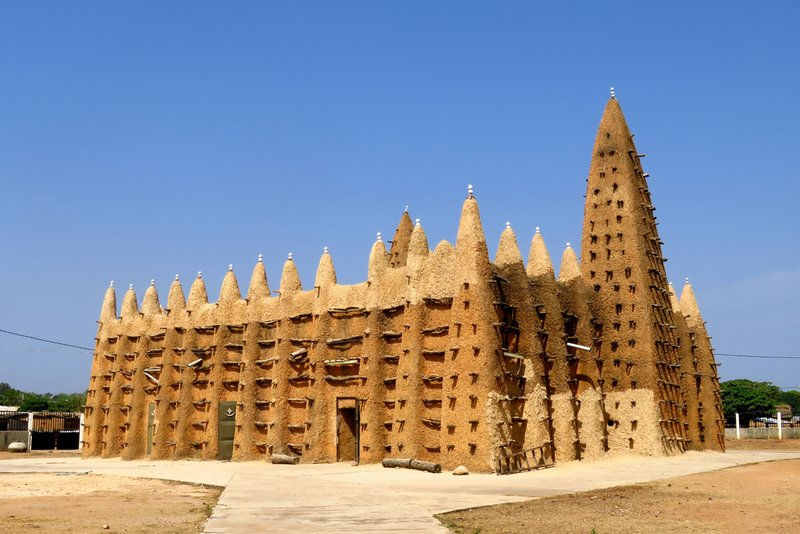
It is apparent that the infrastructure challenges on the continent are closely intertwined with the adoption of Western architectural techniques that are far from being suitable to the African way of life or its local climates. Ivorian architect Tarek Mroue finds ground for humour out of this paradigm. He highlights that the tourists who visit African countries do not dwell in our capitals, as they resemble their own home cities far too much. Instead, they travel far to remote villages where our cultural identity resides.
In 2023, the African Development Bank Group’s Economic Outlook Report estimated that the African continent’s population is projected to double by 2050, reaching a significant human capital base of 2.4 billion people. In a poignant TEDx Talk, Christian Benimana, a Rwandan architect, underscored the heightened pressure to expand cities and build infrastructure that this represents. He speaks of the massive development boom needed to accommodate this many people and highlights that it is an unprecedented endeavor in the history of humankind. Here, we speak of the need to build 700 million more housing units, over 300,000 schools, and 85,000 health centers by 2050. Benimana puts it into perspective for us: this is the equivalent of building 7 health centers, 25 schools, and nearly 60,000 housing units every day for the next 25 years. The implications of such a project extend beyond the technical questions one might ask when undertaking a construction project. We speak here of constructing the visual identity of billions of citizens, of dictating how they will experience space, and of whether these spaces will mirror back who they are, how they live, and what they represent as a people.
Ultimately, Benimana asks: Can we develop a uniquely African model of sustainable and equitable development? He speaks of a yearning to gather and provide the solutions for tomorrow’s Africa using architecture as a critical tool in that process. What if Abidjan did not have to look like Paris? Kigali did not have to look like Beijing? Lagos did not have to look like Miami? What would be the visual identity of those cities, should they mirror the culture of the country they are a part of while keeping in mind sustainability and ecology? Architects, designers, and artists from across the continent have started engaging in this decolonial thinking process, and their work is in equal measure creative and revolutionary.
Francis Kéré is a world-renowned architect from Burkina Faso internationally recognized for his pioneering architectural designs. In a 2022 interview with Al Jazeera, Kéré spoke of his upbringing in a farming family from the remote village of Gando.

There, he grew up with no access to clean water or electricity. Because Kéré’s father wanted him to read and write, he sent him away to live with another relative in a village with a school. He distinctly recalls studying in a hot and dark classroom of 100 kids and on benches with nails sticking out of them. This first classroom experience served as an inspiration to improve the educational life of other children like him. Eventually, Kéré moved to Berlin, where he worked as a carpenter and attended night school to finish his high-school degree. While completing his studies, Kéré returned to Burkina Faso to build his architectural project: The Gando Primary School.
The Gando Primary School is an incredible community-led project. Driven by the idea that everyone deserves comfort, Kéré started designing and fundraising for the school in 1998. The school was ultimately built using traditional construction techniques: Kéré invited the community to participate in the project. Children were invited to bring stones for the foundation, and women to bring water for the foundation while other community members participated in pounding the clay floors. Gando Primary School was constructed to circumvent the issues of poor ventilation and lighting that many schools in the area face. To combat both of these issues, Kéré and his team created a hybrid of clay and cement bricks to provide thermal protection against high temperatures.

They also used corrugated metal roofs alternated by a dry-stacked brick ceiling. Completed in 2001, the Gando Primary School is a beautiful example of a community project that showcases the intelligent use of local materials coupled with modern engineering methods.


The Benin National Assembly is another one of Kéré’s architectural projects that speaks to the creativity and innovation embedded in his work. The Republic of Benin commissioned Kéré Architecture to design a new National Assembly in Porto-Novo that would visually represent the values of democracy and reflect the cultural identity of its people. The layout of the National Assembly developed by Kéré is inspired by the palaver tree, a symbolic West African gathering space used by generations to discuss and problem-solve community issues. The tree is a true African symbol of decision-making and value for communal interests. The “trunk” of the building will be a hollow structure with a central courtyard allowing assembly members in a naturally ventilated and well-lit space. The “roots” of the space will extend into a surrounding public park showcasing Benin’s natural flora— simultaneously promoting transparency and providing shaded space for passersby. The Assembly has been under construction since March 2021.


In 2023, Kéré became the first African and first Black person to receive the Pritzker prize, architecture’ most prestigious honour. Across the continent, he is often referred to as the architect of tomorrow’s Africa. The Berlin-based architect is well known for building schools, health centers, housing units, municipal buildings, as well as a variety of other public spaces in Burkina Faso, Togo, Benin, Mali, Kenya, Sudan, Mozambique, Denmark, Switzerland, Italy, Germany, the United Kingdom, and the United States. His projects feature a variety of African materials such as eucalyptus wood wraps, local clay, wood, mud bricks, and straw roofs. Kéré continuously aims to give life to traditional African architectural designs while adding a sustainable touch.
The same itch that drove Kéré back to his home village of Gando over two decades ago is present in the young architects of today. In an interview with Ten à l’Antenne, 28-year-old designer of architecture William Tailly shares the ancestral techniques that are close to his heart and the aspirations for the future that undergird his work. Tailly uses an ancestral technique known as rammed earth— or pisé. The construction material used in this technique is primarily composed of mud, sand, clay, and sometimes small amounts of cement that are compressed into different layers. Once dry, the material forms a solid and durable structure. The result features subtle color variation, creating unique characteristics of durability, versatility, and aesthetic appeal. Tailly presents the incentive to use this technique quite simply: it is the simplest construction technique available to Africans because mud is a local material available everywhere on the continent. He, too, dreams of a continent where ancestral architectural techniques are repopularized and wherein architecture finally reflects the continent’s climate, lands, as well as the lifestyles and habits of its people.
Ultimately, this wave of reimagined architectural design arises from the acknowledgment of ancestral methods as well-thought out and from the desire to draw from them. African architectural practices diverge from Western ones in that they value non-permanence and emphasize a working relationship with nature. In her work, Prussin observed the practices of the Aboure people of the Ivory Coast, where entire villages moved every generation to make room for deceased ancestors. She notes that non-permanence as a value “does not presuppose the absence of a stable system of ‘place’: rather, it connotes renewal, rejuvenation, rebirth”. Among many African tribes, land occupation has commonly been rotated to circumvent over-farming or the depletion of natural resources. Thus, villages were built so that they could be easily dismantled with little to no effect on the natural landscape of the land. This cyclical view of humanity’s place in the world directly opposes the teachings of the colonial thinking that plagues Western architectural practices. In tandem, African practices often favor the use of naturally available materials that are adaptable to the local environment and climate. The visual architects part of this new movement value the same things: ecology, sustainability, and the beauty of an African visual identity through the use of materials, textures, and culturally-inspired spatial layouts. Their work is essentially to put the “decolonial” in “architecture”, recognizing that the African reality— near and far— is in need of both.
Benimana has launched the African Design Centre to start expanding this community of designers and architects. Together, they are learning to tackle challenges such as urbanism and climate change by developing innovative infrastructure solutions and processes. Francis Kéré’s firm, Kéré Architecture, employs 12 to 16 architects working on similar projects across the world. Here, “back to mud” is an analogy for something far more expansive. It speaks to the ingenuity to forge a path ahead that once already existed, but to do so with the design confidence to remodel it. In that sense, mud is both our past and our future.


Comments