The Cocoa Route: From Ivorian Beans to Fine Belgian Chocolate, and All the Exploitation in Between
The chocolate bar has become a staple item with which to rejoice during the holidays, to nibble on in instances of late-night cravings, and to gift for almost any special occasion. It brings comfort and is universally associated with pleasure and indulgence. Yet, behind the joy that chocolate brings, there exists a dark industry plagued with neocolonial incentives, systemic violence, and continued exploitation. Though social responsibility is often but an afterthought when rejoicing in the delicacy, feeling answerable to the journey from the bean to the bar is the decisive sentiment upon which rests the prolongation of smallholder farmer poverty, West African deforestation, and child trafficking practices.
Rich in colourful textiles, vibrant history, and century-long cultural traditions, the African continent is also home to 60% of the world’s arable land— the largest share of land suitable for agricultural production. Across the continent, abundant natural resources also prevail: The Democratic Republic of Congo is known for its copper, cobalt, and gold; Kenya for its tea, coffee, and flower farms; South Africa for its metal, ores, and diamond; and Nigeria for its oil. On the African Gulf of Guinea lies Côte d’Ivoire, the number one exporter of cocoa in the world. Cocoa export is a vital pillar of the Ivorian economy, accounting for 14% of the country’s GDP. The cocoa industry creates one million jobs, supports an estimated five million Ivorians, and also generates half of the country's export revenue. As such, it naturally accounts for much of the country’s stability and economic prosperity. Nonetheless, what appears to be a flourishing industry is in reality a decaying cocoa supply chain. And, it took nothing more than one documentary to propel this conversation to the international stage.
In 2000, a BBC documentary titled Slavery: A Global Investigation was released. The documentary exposed troubling testimonies of children trafficked to work in West African cocoa farms. In interviews, these children speak of being kidnapped, taken to cocoa farms, and forced to work for no pay. Among the enslaved workers interviewed, Drissa, a young child who worked on cocoa farms for over five and a half years, recounts having his hands tied behind his back and being beaten in cases when he attempted to escape. His message to the world is chilling, yet deeply necessary: our chocolate is the fruit of labor he reaped no benefit for, our indulgence is, in his own words, the equivalent of “eating [his] flesh.” Drissa’s reality is that of 1.5 million children in West Africa’s cocoa farms. The Food Empowerment Project, a non-profit organization working towards food justice, works closely with communities to understand the many processes that lead to child labor and trafficking. In some cases, children are trafficked from neighboring countries such as Mali to work on cocoa farms in Côte d’Ivoire. In others, parents who work in cacao production include their children in the harvest or, in the worst of cases, those who need additional income sell them to traffickers. In most cases, these children are subjected to unsanitary housing, debt bondage, poor working conditions, and long working hours. Their stories— stories of what we must rightfully identify as modern slavery— sparked international outrage upon the release of the documentary. Such sentiments led Western governments to threaten to boycott the chocolate industry, which, in turn, convinced regulators that it could fix its child labor issue by 2005. Needless to say, this deadline was not met. In the decades that followed the release of the documentary, researchers, academics, activists, organizations, and journalists started uncovering the question of what truly comprises the cocoa bean supply chain.

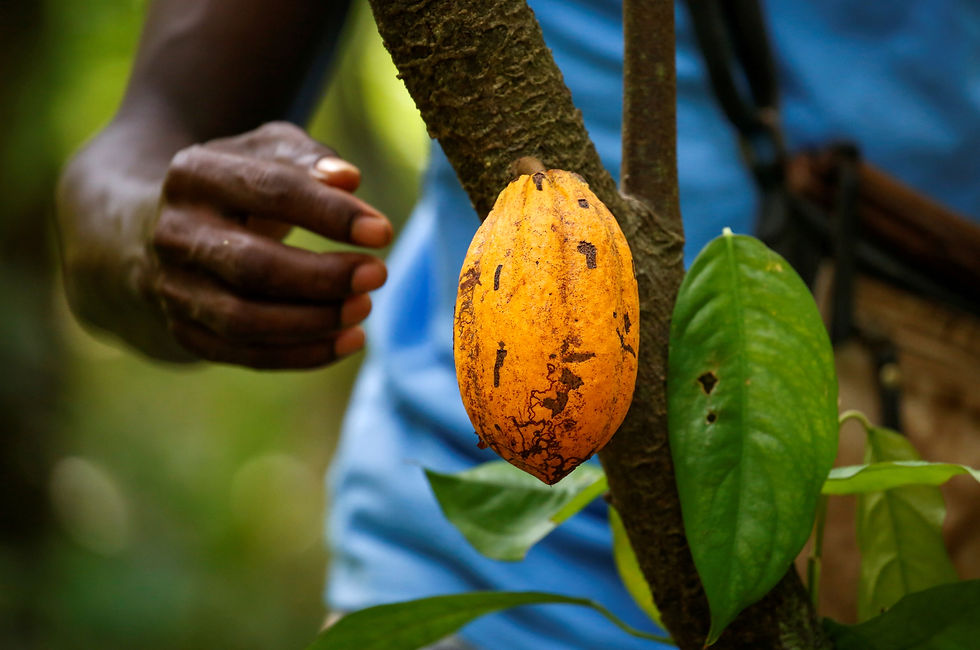
Chocolate as we know it comes from cocoa beans, which exclusively grow in tropical regions 20 degrees north and south of the equator. The world’s top-producing countries of cocoa beans are Côte d’Ivoire, Ghana, Indonesia, Ecuador, and Brazil. Though the cocoa supply chain ends with us as customers, it actually begins with the labor of farmers. In regions across the Côte d’Ivoire, an estimated 5,5 million cocoa farmers harvest cocoa pods using machetes, which they proceed to cut open to collect the beans inside of them. The beans are then piled onto banana leaves and left to dry for six to seven days. When the milky pulp, which surrounds the beans, ferments, it breaks down and unleashes enzymes that produce what many of us commonly know as the chocolate flavor. In 2019, Netflix's Rotten series featured an episode filling in the gap between the long chain from farmer to consumer. The episode, Bitter Chocolate, builds on the stark images of the BBC documentary that preceded it nineteen years earlier by revealing the extent to which chocolate companies are built on an exploitative earnings model— one rooted in the poverty and modern slavery of both young children and adult farmers.
In Côte d’Ivoire, this dire reality is reflected in the lives of cocoa farmers who plant, harvest, collect, dry, and package cocoa beans, yet continue to face low returns and live in extreme poverty. A 2025 Cocoa Household Income Study revealed that 49% of farmers in the country earn incomes below the poverty line. Bitter Chocolate features touching direct accounts from Ivorian farmers. Charles Konan Kouassi expresses how difficult it is for him to pay for basic necessities, especially in cases when disease affects cocoa production and thus reduces his seasonal profits. Eric Koffi Kouassi, another farmer, speaks of the remote village where his family lives in the midst of dire infrastructure and no drinking water, unable to lift themselves out of poverty with his salary alone. To truly grasp their situation, we have to understand the lengthy supply chain that constitutes the flow of the bean from farmer to customer.
After Ivorian farmers have dried and packaged cocoa beans, they sell them directly to middlemen called pisteurs, or buying agents. Pisteurs, the next rung of the ladder on the cocoa supply chain, are the people who physically collect and move the beans from the villages where farmers reside to bring them to the centralized warehouses, called cooperatives. The revenue that cocoa farmers earn for their labor is referred to as the farmgate price, an amount that represents a fraction of the London market price of cocoa. In great neocolonial fashion, the price of cocoa beans is set thousands of miles away from Côte d'Ivoire, in the international markets of London and New York. Though the farmgate price paid to farmers has increased from 750 CFA Francs in 2018 to 2,800 CFA Francs in 2025, there are a variety of procedural factors that continue to entrench cocoa farmers’ poverty. Farmers often live in isolated villages with degraded roads to the closest towns. Because of their lack of bargaining power, they often don’t have a choice as to who to sell their beans to, forcing them to accept a monetary amount below the farmgate price from pisteurs who demand discounts for the state of the roads. Furthermore, though farmgate prices are set by the Ivorian government to protect farmers from global market volatility, pisteurs only pay farmers after they have left their village to sell the beans. For countless cocoa farmers, this process means that their revenue gets lost in the supply chain. Jean-Frédéric Kanga Kouassi recounts having lost 600,000 CFA Francs in 2018, the equivalent of $1,476.10 Canadian dollars, a loss that completely hindered his professional endeavors that year.

From the cooperatives, the cocoa is transported to local exporters who handle the milling, cleaning, and final packaging of export bags. At this stage, the wealthiest middlemen enter the process. The processes and economics of the cocoa supply chain, which are sustained by African poverty and modern slavery, are but an example of what agricultural production looks like on an international scale. It is only once cocoa beans leave the Ivorian market that international traders enter the picture, selling them to chocolate makers in Europe and America. In the chocolate industry, the top traders are Barry Callebaut, Cargill, and the Olam Group; three international companies headquartered respectively in Switzerland, the United States, and Singapore. Nearly every mainstream chocolate product has passed through these traders at some point in the supply chain process. Their choices directly impact cocoa prices and the lives of African communities that depend on that market. Manufacturers and retailers also play an important role in this chain, before the final product reaches customers on store aisles. While the farmer with whom this chain started makes less than two Canadian dollars per day, the chocolate industry, which both controls and benefits from it, makes well over $100 billion in annual revenue.
The biggest chocolate companies whose products we savor have names most of us are no strangers to: Mars Inc, Mars, Inc., Mondelez International, Ferrero, Nestlé, The Hershey Company, Godiva Chocolatier, and Lindt. These are among the influential players in the supply chain who provide us with a luxury item at a cost we seldom question. Indeed, the chocolate industry is sustained by forced labor, child trafficking, and child labor within cocoa farming communities in the Côte d’Ivoire and across the world where cocoa is produced. But the industry harm does not stop there. In Côte d’Ivoire, cocoa production bears high ecological costs as it is the leading cause of deforestation. And, in a cyclical manner, poverty is the biggest driver of deforestation in West Africa. The issue arises when desperate farmers supplement their crop by growing cocoa trees in protected forests where uncultivated soil is more fertile and free of charge. As a result, more than 90% of West Africa's rainforests have disappeared, accelerating both land and environmental degradation. This encroachment on protected forests and parks is a stark reminder of how continued poverty justifies desperate means for vulnerable farmers trying to feed their families.
Lastly, cocoa production is tangled in a long-standing history of colonial ties that reinforce cycles of production for export to the Global North. Ahead of the wave of independence that shook the African continent in the early 1960s, six states— France, Belgium, the Netherlands, Italy, Luxembourg, and Germany— enshrined the European Economic Community (EEC) in the 1957 Treaty of Rome. The Treaty created a common market for its founding members, and simultaneously set out the terms and processes by which the European economy would be “integrated” into that of African colonies. The Treaty of Rome thereby foregrounded the colonial association regime by incorporating Africa’s natural resources into Europe’s economy and sphere of influence. Ironically, though in a sense devoid of humor, the Ad-Hoc Overseas Territories Group tasked with preparing the Treaty included in its report: “The proposed enterprise entails consequences of major importance for the future of Europe. […] In aiding Africa and supporting itself on her, the community of the Six is able to furnish Europe with its equilibrium and a new youth.” This declaration encompasses the vast array of incentives that undergird the European Union’s desire to harness Africa’s resources. In the decades that followed, it also served as the foundation for a neocolonial export-based economy wherein African agriculture became an apparatus to supply the world with food while those who operate this machine remain in a state of hunger.
Many of the farmers in Bitter Chocolate spoke of the feeling that comes from working for a product whose taste they do not themselves know. The deep sadness in these stories is juxtaposed with the truth that when one’s economy is designed around export and not production for local consumption, the taste of that which it labors to create belongs to the white man. In conjunction, such a structure also entrenches economic dependency on export for revenue since African countries’ economies are dependent on foreign exchange and the markets that govern them. Here, I must note that African governments also have their part to play in this system. The disentanglement of African economies from persisting neocolonial schemes requires the political prowess of the continent's leaders, who must be willing to detach themselves from old patterns and reimagine the political processes they employ. If Africa can feed others at its own expense, it certainly can reverse the cadence and learn to provide for its people first. And, if it can harvest unimaginable amounts of natural resources, it must also learn to build the processing plants necessary to consume them.
Today, the continent cannot turn to the West to reinvent the cocoa supply chain. Instead, such solutions must be designed at home. Entrepreneurs like Axel Emmanuel Gbao have started this work. In 2015, Gbao created Le Chocolatier Ivoirien, an Ivorian brand that uses locally-sourced chocolate. The company employs 200 women working to help include them in the value chain. There, they are taught the skills to process cocoa beans into chocolate. The visual identity of his chocolate features distinct Ivorian patterns, and his collection presents flavors from the continent: banana, ginger, pepper, vanilla, and cashew. Le Chocolatier Ivoirien can be found in supermarkets in Abidjan and shops in Paris. Decolonizing the chocolate industry is the vision of other Ivorian brands on the market: Ecoya, Ivory Blue, and Choco Black. Together, they represent the pioneers that Côte d’Ivoire and the continent at large need to launch a decolonial African food movement.

As companies pivot to developing backless chocolate sustainability programs that neither directly involve farmers nor have been proven to have large-scale impacts, the onus returns to the one for whom this industry was created in the first place: the chocolate customer. Customers of the Global North are particularly answerable to the conditions that enable their consumption. From Côte d’Ivoire to Ghana, and across all the nations where farming labor drives the chocolate industry, solidarity with cocoa farmers also requires remembering that consumers are far closer to living the farmer’s precarity than the trader’s privilege.
Comments